Your Website Should Run Your Business, Not Just Describe It
For a long time, small business owners had two real choices when they wanted a website. Pay a few thousand dollars for a brochure-style site that just sits there. A digital business card with a contact form. Or pay an agency $15,000 to $50,000 for something custom that actually does work for you. The kind of operational build with payments, customer accounts, scheduling, and real workflows routinely lands in the $25K–$50K range, and that’s before you get to the multi-month timeline.
The middle option, affordable software that actually runs your business, didn’t really exist. Most owners ended up with the brochure and a duct-taped pile of separate tools to handle the actual operations: Squarespace for the site, Mailchimp for email, Calendly for booking, QuickBooks for invoicing, a Google Drive folder for photos, a different app for payments, and a spreadsheet that pretends to tie it all together.
That’s changed. I want to show you what changed, and what three of my clients are running today that they couldn’t have gotten five years ago.
The Brochure Problem
If you run a small service business (a photo studio, a nonprofit museum, a hall of fame, a contractor, a landscaping crew), your website should be doing something for you every day. Not just existing.
It should be where customers book sessions. Where members renew. Where your team updates the hours. Where your inductees are searchable. Where the orders come in.
Instead, what most small businesses get is a digital pamphlet plus a junk drawer of disconnected SaaS subscriptions. Each one has its own login, its own monthly bill, and its own quirky way of not quite fitting how you actually operate.
That gap, between “a brochure” and “an enterprise build,” is what I’ve spent the last couple of years filling for small businesses across New England. Here are three of them.
Little Big Leaguers Photography: A Studio That Doesn’t Bend to Software
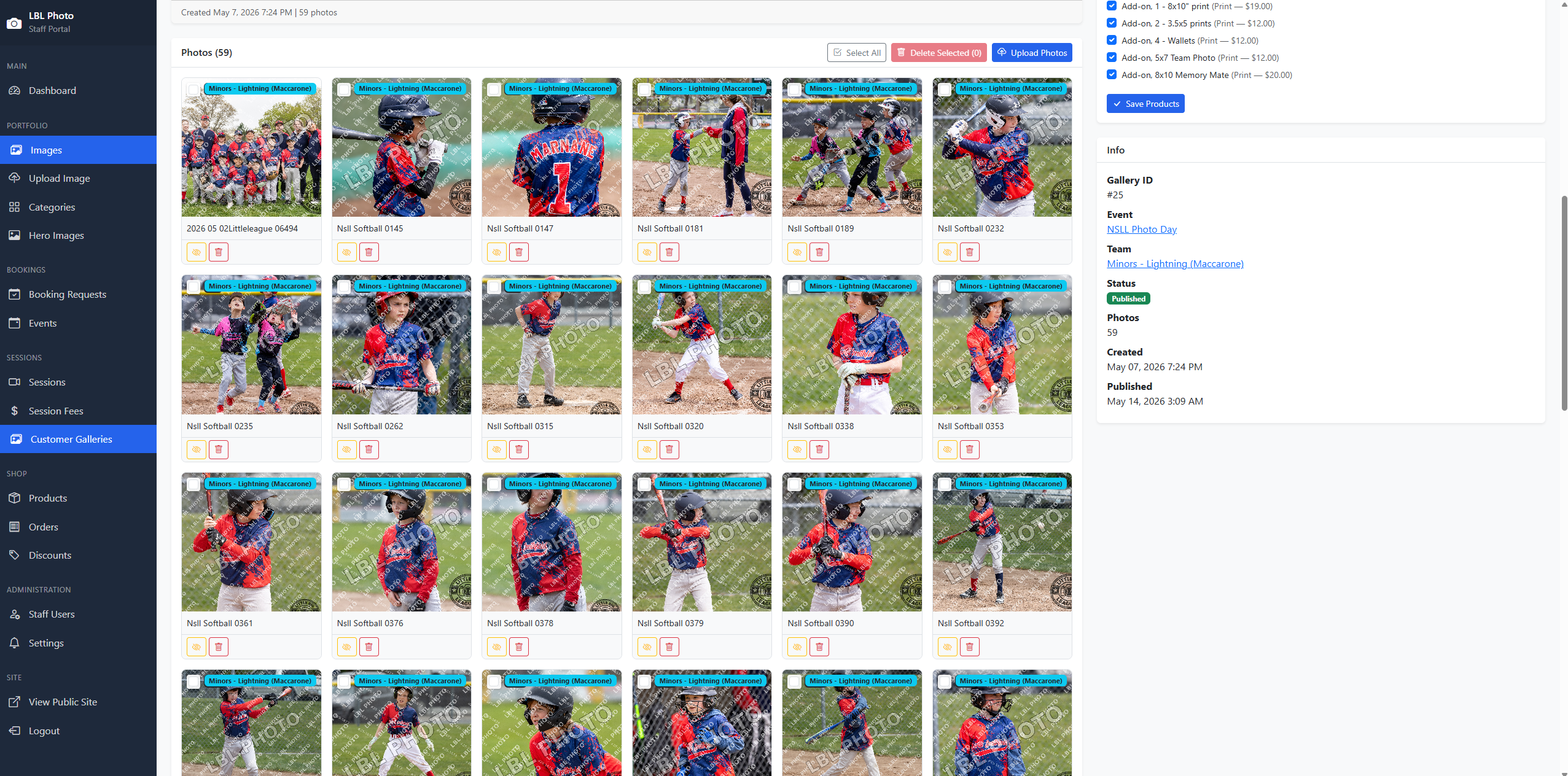
T.J. is just getting Little Big Leaguers Photography off the ground. He shoots kids’ sports (soccer, baseball, basketball), both individual and team.
Here’s the thing about T.J.’s business: it doesn’t look like any one off-the-shelf photography platform’s idea of a photo business.
Some weeks he’s doing a one-on-one shoot. A parent who wants individual photos of their kid, nothing else. Other weeks it’s a full team-photo day with a roster of 60 kids across multiple teams. Other times he just shows up to a random basketball game, shoots a couple hundred frames, and uploads a gallery for parents to scroll through. And every order can end up as a digital download, a physical print from a local printer he trusts (and happens to be friends with), or both.
SmugMug, ShootProof, Pixieset: they all kind of handle pieces of this. None handle all of it without forcing T.J. to bend his workflow around their assumptions. The local-print fulfillment loop is the killer. No SaaS gallery platform has “route this order to T.J.’s buddy down the road who does the printing” as a feature.
So we built him exactly that. Bookings, sessions, private customer galleries with shareable access tokens, Stripe payments, watermarked previews, a cart that handles digital and physical mixed orders, discount codes, automatic email notifications, download tokens for paid digital files. The fulfillment flow knows when an order needs to route to the local printer.
T.J.’s software fits T.J.’s business. Not the other way around.
Hollis Historical Society: A Single Pane of Glass for a Volunteer-Run Nonprofit
The Hollis Historical Society is run by volunteers. Like most small nonprofits, they had accumulated a stack of tools over the years that all sort of worked and none of which talked to each other: a Weebly site, a couple of antiquated on-prem software packages for member records and scheduling, a separate email tool, a Facebook page where some events lived.
Updating the museum’s open hours, especially around holidays when the schedule has exceptions, meant changing it in three places and hoping you remembered them all. Posting an event meant copying the same blurb into multiple systems. Sending an announcement was its own production.
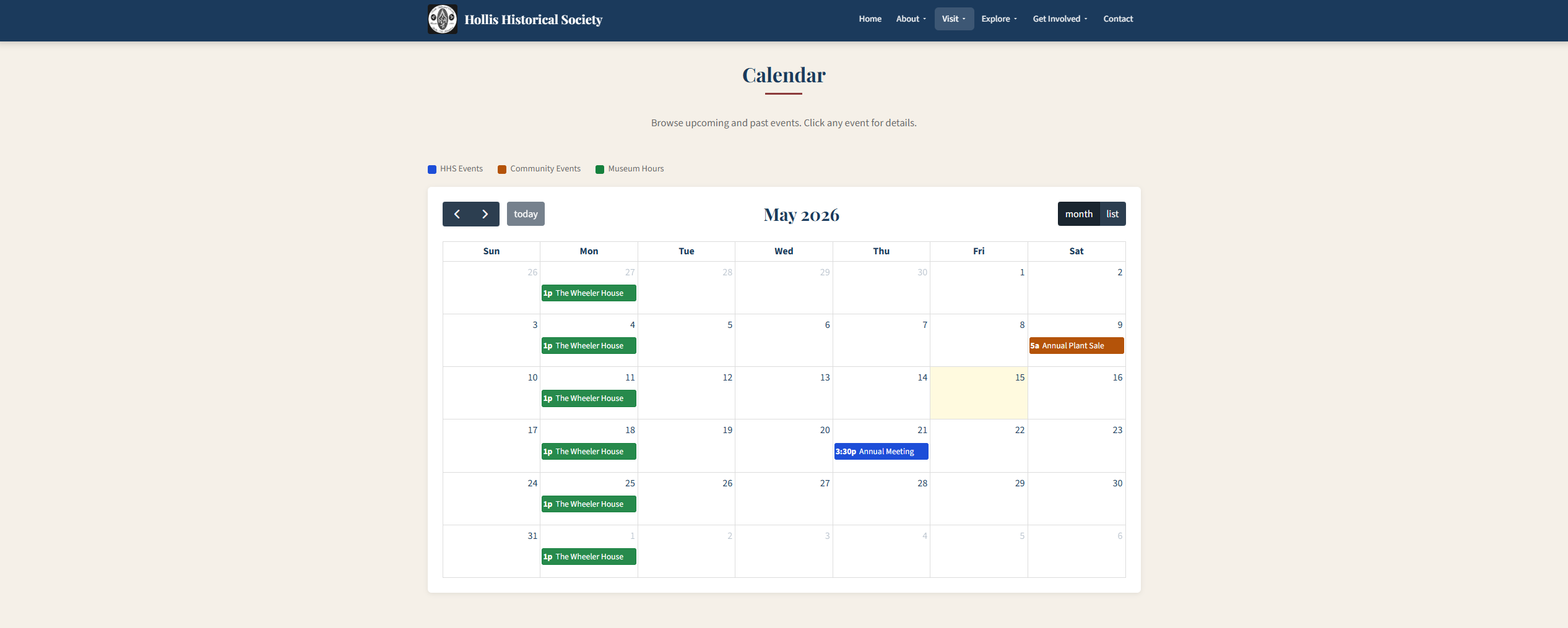
What they wanted was simple: one place to log in and run the organization. So that’s what we built. A Granite-powered dashboard. Single pane of glass. Museum hours with recurring schedules and holiday exceptions that automatically flow to the public site. Events with organizers and programs. Announcements, featured articles, a curated video library, a logged-in member portal.
The volunteer running the dashboard doesn’t need a PhD in any of it. She updates hours in one place. The public site reflects it the next second.
New Hampshire Golf Hall of Fame: Software That Only Has to Be Easy Once a Year
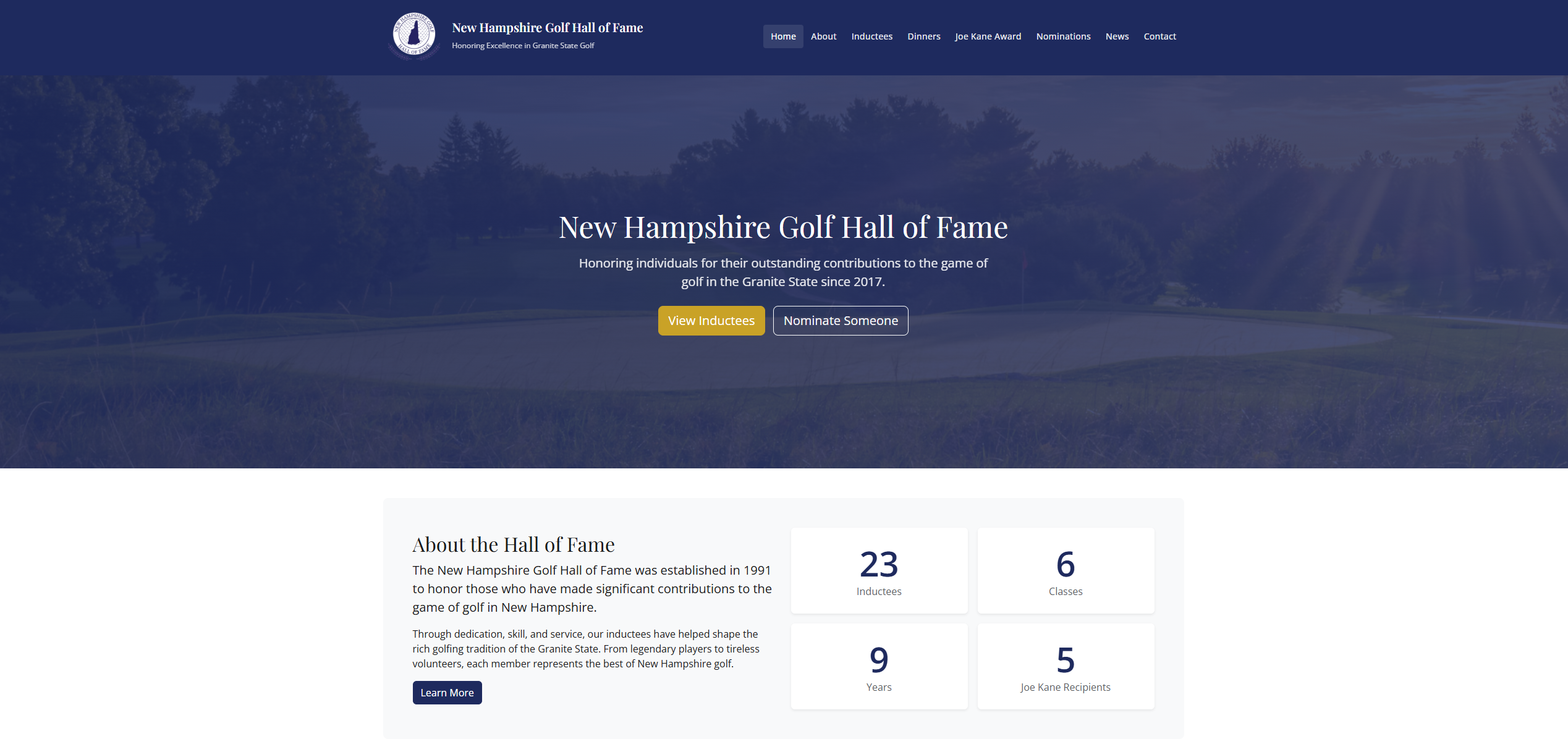
The NH Golf Hall of Fame had a WordPress site. It mostly worked. But WordPress is a generic CMS. It doesn’t natively understand the concept of a “Hall of Fame class,” or an “inductee,” or an “annual induction dinner with a photo gallery.” Every one of those had been forced into the WordPress page/post/plugin shape, which meant updates were clunky, the inductee archive didn’t behave like a real archive, and managing the once-a-year induction workflow was an exercise in remembering which plugin did what.
Here’s the killer constraint on a Hall of Fame website, and it’s one most generic software gets wrong: the people running it only use it once a year. When the next induction class rolls around, the admin needs to feel obvious, because nobody’s been logged in for ten months. WordPress isn’t obvious. It’s flexible, which is a different thing.
The Granite app we built for them models the actual domain. Inductee Classes by year. Inductees attached to a class. Joe Kane Award recipients. Annual Dinners with photo galleries. Committee members. A blog. Every screen in the admin is shaped around how the Hall actually operates, not how a generic CMS thinks about pages.
When this year’s class is announced, the workflow is: log in, create the class, add the inductees, upload the dinner photos. That’s it. Easy once a year, because once a year is the only time it ever has to be.
So How Is One Guy Doing All This?
This is the part I want to be honest about, because if you stop and think about the above for a second, it sounds a little nuts. Three custom apps for three completely different businesses, plus the 30-odd other sites I host? Five years ago, this would have been a multi-person agency doing year-long engagements per client. So what changed?
Two things, working together.
First, I built a platform. I call it Granite. Every Zimventures client site runs on it. Granite handles the boring 70% that every small business website needs and that I have no interest in writing three times: multi-tenant hosting, deploys, admin scaffolding, contact forms, spam protection, transactional email delivery, analytics, monitoring, security headers, and the newsletter platform I wrote about a couple months ago. When a new client comes on, I’m not starting from “blank Django project.” I’m starting from “they already have a hosted, monitored, deliverable, spam-protected, analytics-enabled site.” That’s day one.
Second, AI compresses the custom 30%. I work with Claude (Anthropic’s AI assistant) to think through the domain. What’s a “session” for T.J.? What’s a “class” for the Hall of Fame? What does Hollis’s hours schedule actually need to model? Then Claude Code and GitHub Copilot do the heavy lifting on implementation, working against the Granite codebase with full context. I’m still doing the product thinking, the client conversations, the architectural calls. But the part where I sit there hand-typing the 47th admin view? That’s compressed by an order of magnitude.
Neither piece is the whole story. A solo developer with AI but no platform spends every engagement reinventing auth and contact forms. A solo developer with a platform but no AI is moving at 2019 speed on the custom parts. Together, the math finally works for small businesses.
The result, for clients: enterprise-grade custom software at small-business prices. Not “an off-the-shelf SaaS with your logo on it.” Software that’s actually shaped around how your business operates.
What This Means For Your Business
If you’re a small business owner (a photographer, a contractor, a nonprofit, an electrician, a landscaper, a local hall of fame) and your “website situation” right now is a brochure plus seven SaaS logins, you’re leaving leverage on the table. The bar for what a small business should expect from its website has moved. Quietly, but a lot.
You should expect the website to be where you actually run the business. Bookings, customers, schedules, content, payments, the whole loop. One login. One bill. Software that fits you, not software you’ve bent your business around to fit.
That’s what Zimventures does, and that’s what Granite is for. If you’re running a small business anywhere in New England and you’re tired of the duct-taped SaaS stack, I’d love to talk.
Get in touch for a free consultation.
